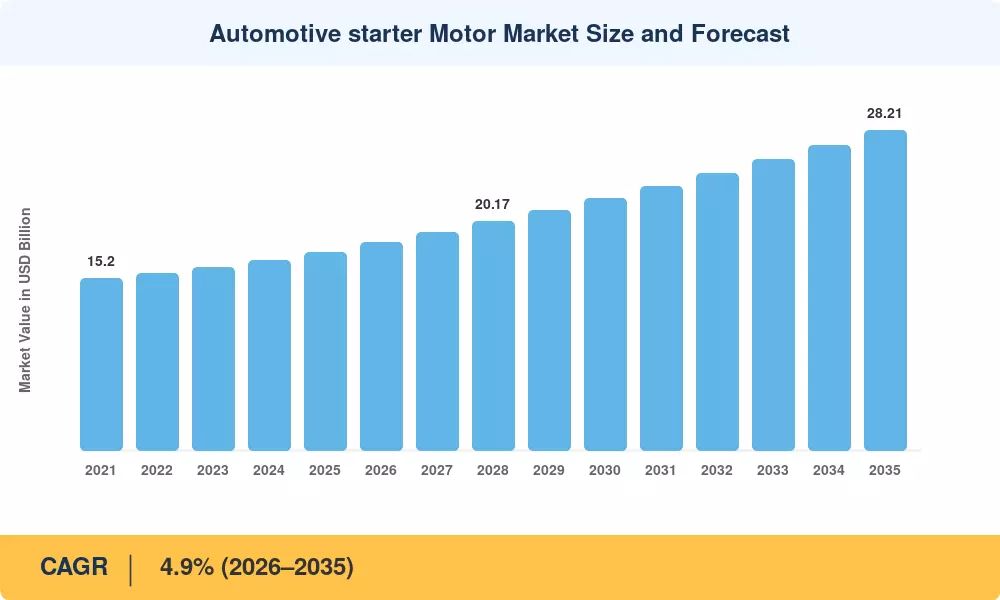
Automotive Starter Motor Market to Reach USD 28.21 Billion by 2035, Growing at 4.9% CAGR
Passenger cars account for approximately USD 12.24 Billion of the Automotive Starter Motor Market in 2025, driven by
Press Release Disclaimer: This is a press release distributed through the XPR Media network. It has not been independently verified by our newsroom.

Passenger cars account for approximately USD 12.24 Billion of the Automotive Starter Motor Market in 2025, driven by global stop-start mandates.
NEW YORK, NY, UNITED STATES, August 26, 2026 /EINPresswire.com/ — According to Market Research Future, the Automotive Starter Motor Market is projected to grow from USD 18.33 Billion in 2026 to USD 28.21 Billion by 2035, registering a CAGR of 4.9% across 2026 to 2035, driven by integration of advanced electric vehicle technologies. This steady growth trajectory reflects the evolving landscape of automotive propulsion systems, where starter motors continue to play a vital role despite the industry’s gradual transition toward electrification. The market’s resilience is underpinned by sustained demand for internal combustion engine vehicles in developing economies, the growing popularity of hybrid and micro-hybrid vehicles that require sophisticated starting systems, and ongoing technological advancements that enhance starter motor efficiency and reliability.
Market Overview
Automotive starter motors are electromechanical devices designed to initiate internal combustion engine operation by cranking the engine flywheel to achieve the necessary rotational speed for combustion. These critical components transform electrical energy from the vehicle battery into mechanical energy, enabling the engine to start reliably under various environmental conditions. The starter motor market encompasses a diverse range of products including electric starters, pneumatic starters, hydraulic starters, and integrated starter generators, catering to different vehicle types and powertrain configurations.
The key growth drivers propelling this market forward include the steady global production of internal combustion engine vehicles, which continues to dominate automotive manufacturing despite the rising popularity of electric vehicles. The expansion of the commercial vehicle segment, driven by global e-commerce growth and logistics industry development, creates substantial demand for robust starter motors capable of withstanding heavy-duty operating conditions. The growing adoption of start-stop systems in conventional and hybrid vehicles is another significant driver, as these systems require more durable and frequently operated starter motors that can handle hundreds of thousands of start cycles over the vehicle lifetime. Additionally, the increasing integration of advanced electric vehicle technologies is driving innovation in starter motor design, making them more efficient, compact, and reliable.
Technological developments are reshaping the starter motor landscape through continuous innovation. The emergence of integrated starter generators represents a significant advancement, combining the starter motor and alternator functions into a single unit that enables smoother start-stop operation, regenerative braking, and improved fuel efficiency. These systems are particularly important in micro-hybrid vehicles where the integrated starter generator performs both engine starting and battery charging functions. Manufacturers are also developing brushless direct current starter motors that offer higher efficiency, longer service life, and reduced noise compared to traditional brushed motors. The integration of power electronics and intelligent control systems enables more sophisticated starting strategies that optimize performance based on engine temperature, battery state of charge, and environmental conditions.
Policy and regulatory frameworks exert significant influence on market dynamics across regions. Stringent emission regulations worldwide are compelling automakers to adopt technologies that reduce fuel consumption and emissions, including start-stop systems that require advanced starter motor technology. Corporate Average Fuel Economy standards in various regions are driving the adoption of micro-hybrid and hybrid technologies that rely on enhanced starting systems. Government incentives for fuel-efficient vehicles are accelerating the adoption of start-stop systems, consequently boosting demand for high-durability starter motors. Regulatory push for vehicle electrification is also influencing the market, as hybrid vehicles require specialized starter motor systems that differ from those in conventional vehicles.
📍 Get Free Sample Report for Detailed Market Insights:
https://www.marketresearchfuture.com/sample_request/5626
Market Segmentation
The automotive starter motor market is segmented based on vehicle type, application type, type, sales channel, and regional analysis to provide comprehensive insights into industry dynamics.
By Vehicle Type: The market is categorized into Passenger Cars and Commercial Vehicles. Passenger cars constitute the dominant segment, driven by high global production volumes and consumer demand for reliable starting systems. The growing adoption of start-stop technology in passenger cars to meet emission regulations is boosting demand for robust starter motors capable of frequent operation. Commercial vehicles, including trucks, buses, and light commercial vehicles, represent a substantial segment characterized by demanding operating conditions and the need for high-durability starter systems. The expansion of e-commerce and logistics has increased commercial vehicle production and sales, particularly in developing countries, supporting starter motor demand in this segment.
By Application Type: The market is divided into Internal Combustion Engine and Hybrid/Micro-Hybrid Powertrain segments. The Internal Combustion Engine segment currently dominates the market as vehicles powered by gasoline and diesel engines continue to represent the vast majority of global vehicle production. These conventional powertrains require reliable starter motors to initiate engine operation, with demand driven by vehicle production volumes in emerging markets and replacement needs in mature markets. The Hybrid/Micro-Hybrid Powertrain segment is experiencing rapid growth, driven by increasing consumer demand for fuel-efficient vehicles and regulatory pressure to reduce emissions. Micro-hybrid vehicles utilize start-stop systems to automatically shut down the engine during idle periods and restart when needed, significantly increasing the frequency of starter motor operation. This application requires enhanced starter motor durability and represents a high-growth opportunity for manufacturers capable of delivering robust solutions.
By Type: The market encompasses Electric, Pneumatic, Hydraulic, and Starter Motor Generator types. Electric starters dominate the global market, favored for their efficiency, reliability, and broad applicability across vehicle types. The Starter Motor Generator segment is experiencing the fastest growth, driven by the increasing popularity of micro-hybrid vehicles where integrated starter generators enable smooth start-stop operations, regenerative braking, and improved fuel efficiency. Pneumatic and hydraulic starters serve niche applications, primarily in heavy commercial vehicles and industrial equipment where high torque output is required. The Automotive Ignition System Market works in conjunction with starter motors, as both systems are essential for internal combustion engine operation, with innovations in one area often driving complementary advances in the other.
By Sales Channel: The market is segmented into Original Equipment Manufacturers and Replacement/Aftermarket. OEMs represent the largest sales channel, driven by global vehicle production volumes and the direct integration of starter motors in new vehicles. The OEM segment is characterized by long-term supply agreements, stringent quality requirements, and close collaboration between automakers and component suppliers. The Replacement/Aftermarket segment is substantial and growing, driven by the aging global vehicle fleet and the need for starter motor replacement due to wear, electrical failure, or mechanical damage. The aftermarket offers opportunities for manufacturers to capture recurring revenue through replacement parts and is particularly important in regions with high vehicle average age.
By Region: The market covers North America, Europe, South America, Asia Pacific, and the Middle East and Africa. Asia Pacific dominates the global market, driven by massive automotive manufacturing volumes, rapid urbanization, and increasing vehicle penetration. China leads the regional market with the world’s largest automotive production base and growing adoption of fuel-saving technologies. India represents a significant growth market with expanding vehicle production and increasing consumer preference for passenger cars. North America follows as a mature market with strong replacement demand, while Europe represents a technologically advanced market driving innovation in starter motor technology for hybrid and micro-hybrid applications.
🛒 You can buy this market report at:
https://www.marketresearchfuture.com/checkout?currency=one_user-USD&report_id=5626
Regional Analysis
Asia Pacific leads the global automotive starter motor market, commanding a dominant share driven by massive automotive manufacturing volumes, rapid urbanization, and increasing vehicle penetration across the region. China dominates the regional market, with the world’s largest automotive production base producing millions of vehicles annually. The Chinese government’s continued support for the automotive industry and the country’s role as a global automotive production hub sustain starter motor demand. The increasing adoption of start-stop technology in Chinese passenger vehicles as part of fuel-saving initiatives is driving demand for advanced starter motor solutions. India represents another significant growth market with expanding vehicle production and increasing consumer preference for passenger cars driven by rising income levels and urbanization. The country’s large automotive manufacturing base and growing emphasis on fuel efficiency create substantial opportunities for starter motor suppliers. Japan and South Korea, as major automotive manufacturing hubs with technologically advanced vehicle production, require sophisticated starter motor solutions, particularly for hybrid vehicle applications. Asia Pacific also benefits from the growing adoption of hybrid and micro-hybrid vehicles in countries like Japan and South Korea, creating demand for integrated starter generators and advanced starting systems.
North America represents a mature but substantial market, characterized by high vehicle ownership rates, a large replacement and aftermarket segment, and the growing adoption of fuel-efficient technologies. The United States dominates the regional market, with the world’s largest vehicle parc and strong demand for replacement starter motors. The region’s pickup truck and SUV dominance, which favors large engines requiring robust starter motors, further supports market demand. The growing adoption of start-stop technology in newer vehicles, driven by Corporate Average Fuel Economy standards, is creating demand for high-durability starter motors. Canada’s automotive market, closely linked to U.S. trends, shows similar patterns of vehicle demand and replacement needs. Mexico’s strong automotive manufacturing industry, producing vehicles for North American markets, supports starter motor demand through OEM sales. The region’s mature aftermarket presents opportunities for replacement part suppliers, while the trend toward vehicle electrification is gradually influencing product development strategies.
Europe represents a technologically sophisticated market driving innovation in starter motor technology, particularly for hybrid and micro-hybrid applications. The European Union’s stringent emission regulations and commitment to reducing carbon emissions are accelerating the adoption of start-stop technology and hybrid powertrains, boosting demand for advanced starter motor solutions. Germany leads the region as the largest European automotive market, with major automakers investing heavily in hybrid technology and fuel-saving solutions. France, the UK, and Italy represent significant markets with strong automotive industries. The European market’s focus on fuel efficiency and emission reduction creates opportunities for starter motor manufacturers capable of delivering high-durability, efficient products. The region’s well-developed aftermarket segment and aging vehicle fleet support replacement part demand. The Automotive Electrical Distribution System Market is closely tied to starter motor developments, as both are integral to vehicle electrical systems and benefit from the increasing electrification of automotive components.
South America and the Middle East and Africa represent developing markets with significant growth potential. South America, led by Brazil and Argentina, benefits from improving economic conditions and increasing vehicle production. Brazil’s status as a major automotive manufacturing hub in the region sustains starter motor demand through OEM sales. Growing vehicle ownership and the region’s developing aftermarket segment create additional opportunities. The Middle East and Africa, led by the UAE and Saudi Arabia, are experiencing steady growth driven by urbanization, increasing vehicle penetration, and improving automotive manufacturing capabilities in certain countries. South Africa’s developing automotive manufacturing base supports starter motor demand, while the region’s growing vehicle parc offers aftermarket opportunities.
Competitive Landscape and Key Players
The automotive starter motor market is characterized by intense competition among established component manufacturers, with key players focusing on technological innovation, strategic partnerships, and geographic expansion to strengthen their market positions. The market is moderately consolidated, with a mix of global suppliers and regional manufacturers competing for market share.
Major companies operating in this space include Denso Corporation, Bosch Limited, Valeo Group, Mitsubishi Electric Corporation, Mahle GmbH, Hitachi Astemo, Ltd., BorgWarner Inc., Nidec Corporation, Mitsuba Corporation, Remy International, Delco Remy, Motorcar Parts of America, and Ningbo Shuanglin Auto Parts Co., Ltd. These industry leaders invest heavily in research and development to create innovative starter motor solutions that meet evolving vehicle requirements and regulatory standards.
Strategic developments are reshaping the competitive landscape as companies adapt to industry transformation. Leading manufacturers are expanding their product portfolios to include integrated starter generators and starter motor systems compatible with micro-hybrid and hybrid powertrains. Strategic collaborations between starter motor suppliers and automakers are becoming increasingly important for developing customized solutions and ensuring early integration into vehicle development programs. Acquisitions and partnerships are consolidating expertise in areas such as brushless motor technology, power electronics, and intelligent control systems. Geographic expansion into emerging markets, particularly Asia Pacific, is a key strategy for manufacturers seeking to capture growth opportunities in high-production regions.
Latest Industry News and Developments
Recent industry developments highlight the dynamic evolution of the automotive starter motor market and the strategic responses of key players to emerging trends. In a significant technology showcase, a major automotive component supplier unveiled its next-generation integrated starter generator system designed for 48-volt mild hybrid applications, featuring advanced brushless motor technology and integrated power electronics for enhanced efficiency and performance.
Another notable development involves a prominent starter motor manufacturer announcing a strategic partnership with a global automaker to supply advanced starter motor systems for a new line of hybrid passenger vehicles. The partnership focuses on developing starter motors capable of handling the increased start-stop frequency required by the automaker’s advanced hybrid powertrain, reflecting the growing importance of collaborative development in the evolving market landscape.
Market Challenges and Opportunities
The automotive starter motor market faces several significant challenges that require strategic responses for sustainable growth. The most substantial challenge is the global transition toward electric vehicles, as fully electric vehicles do not require traditional starter motors. This trend, driven by regulatory mandates, advancing battery technology, and changing consumer preferences, poses a long-term threat to the conventional starter motor market. The increasing complexity of starter motor systems, particularly those used in start-stop and hybrid applications, demands continuous technological advancement and investment, challenging manufacturers to maintain competitiveness. Price pressure from automakers seeking cost reductions in vehicle production affects profit margins throughout the supply chain. Supply chain disruptions and raw material price volatility, particularly for copper used in motor windings and rare earth materials used in permanent magnets, create additional operational challenges.
Emerging opportunities in the market are substantial despite these challenges. The growing popularity of hybrid and micro-hybrid vehicles represents a significant growth opportunity, as these vehicles require more sophisticated and durable starter motor systems capable of handling frequent start-stop cycles. The integrated starter generator segment is experiencing rapid growth, driven by its ability to combine starter and generator functions while enabling regenerative braking and improved fuel efficiency. Manufacturers capable of developing and producing these advanced systems will be well-positioned for success.
To explore more market insights, visit us at:
https://www.marketresearchfuture.com/reports/automotive-starter-motor-market-5626
Final Market Summary
The long-term industry potential remains supported by the massive global vehicle fleet and the continued production of vehicles requiring starter motors, particularly in emerging markets where vehicle penetration continues to rise. However, the market is undergoing transformation driven by the electrification trend, which presents both challenges and opportunities. While electric vehicles represent a long-term threat to traditional starter motors, the hybrid and micro-hybrid segment offers substantial growth opportunities for manufacturers capable of developing advanced starting solutions.
More Related Reports from MRFR Library:
Garbage Truck Market : https://www.marketresearchfuture.com/reports/garbage-truck-market-22481
Hydrofoil Boat Market : https://www.marketresearchfuture.com/reports/hydrofoil-boats-market-22485
River Cruise Market : https://www.marketresearchfuture.com/reports/river-cruise-market-22496
Luxury Electric Vehicle Market : https://www.marketresearchfuture.com/reports/luxury-electric-vehicle-market-22500
Luxury Suv Market : https://www.marketresearchfuture.com/reports/luxury-suv-market-22511
Microcars Market : https://www.marketresearchfuture.com/reports/microcars-market-22516
Mobile Car Wash and Detailing Market : https://www.marketresearchfuture.com/reports/mobile-car-wash-detailing-market-22528
Vehicle to Grid Market : https://www.marketresearchfuture.com/reports/vehicle-to-grid-v2g-market-22533
Passenger Ferries Market : https://www.marketresearchfuture.com/reports/passenger-ferries-market-22555
Ev Charging Cable Market : https://www.marketresearchfuture.com/reports/ev-charging-cable-market-22628
Market Research Future
Market Research Future
+1 855-661-4441
email us here
Legal Disclaimer:
EIN Presswire provides this news content “as is” without warranty of any kind. We do not accept any responsibility or liability
for the accuracy, content, images, videos, licenses, completeness, legality, or reliability of the information contained in this
article. If you have any complaints or copyright issues related to this article, kindly contact the author above.

Media gallery