Brain Computer Interface Market to Reach $3.7B by 2035
Explore the Brain Computer Interface Market forecast, growth drivers, AI integration, and key applications in healthcare & neurotech. Projecting $3.7B by 2035.
Press Release Disclaimer: This is a press release distributed through the XPR Media network. It has not been independently verified by our newsroom.
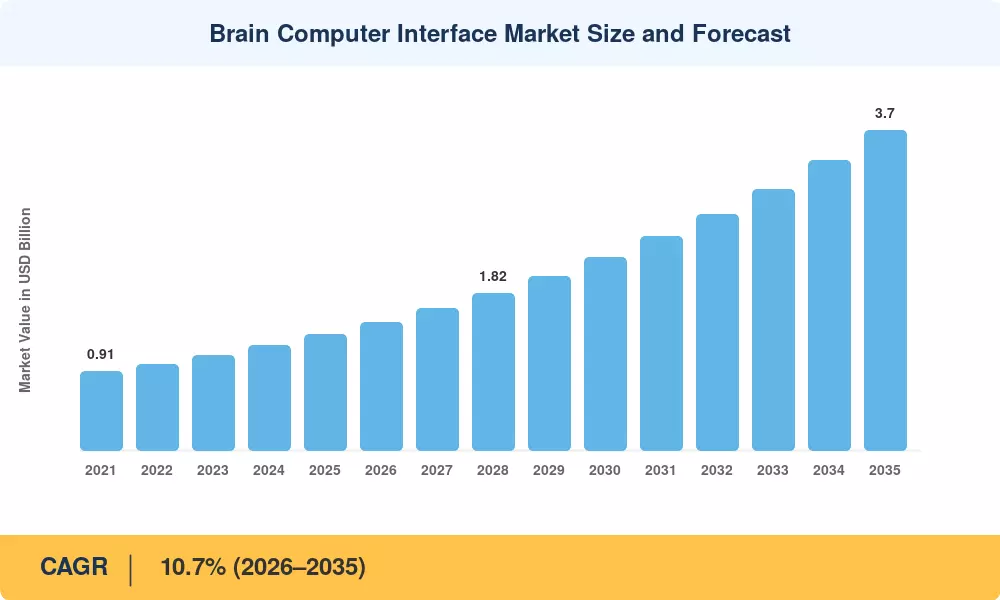

Brain Computer Interface Market is advancing rapidly, driven by neurotechnology, AI, healthcare innovation, and growing demand for brain-controlled devices.
NEW YORK(NY), NY, UNITED STATES, September 8, 2026 /EINPresswire.com/ — The Brain Computer Interface Market is developing rapidly as neuroscience, artificial intelligence, machine learning, and advanced biomedical engineering converge to create direct communication pathways between the brain and external technologies. Brain-computer interfaces can interpret neural signals and translate them into commands for computers, robotic systems, prosthetics, and other assistive technologies.
The technology is attracting growing attention because it can potentially improve communication, mobility, rehabilitation, and human-computer interaction. Research institutions, healthcare organizations, technology companies, and investors are advancing solutions that capture and decode brain activity with increasing precision, while improvements in signal processing and artificial intelligence are supporting more practical applications.
Brain Computer Interface Market closed 2025 at roughly USD 1.34 billion and opens the forecast window at USD 1.48 billion in 2026, climbing to USD 3.70 billion by 2035 at a 10.7% CAGR. This expansion reflects increasing investment in neural interfaces, rising demand for neurological rehabilitation technologies, and growing research into direct brain-controlled communication and assistive systems.
Click Here to Get Sample Premium Report –
https://www.marketresearchfuture.com/sample_request/58581
Growing Adoption of Neural Interface Technology
The growing prevalence of neurological disorders and physical disabilities is encouraging researchers to explore technologies capable of restoring communication and movement. Brain-computer interfaces can potentially enable individuals with severe motor impairments to control computers, robotic limbs, communication devices, or other systems through neural activity.
Healthcare applications remain among the most promising areas for the technology because BCIs can support rehabilitation following neurological injuries and help researchers develop alternative communication methods. Improvements in non-invasive and minimally invasive approaches are also broadening research opportunities, allowing developers to investigate applications while addressing safety, usability, and clinical requirements.
Artificial Intelligence Accelerates BCI Development
Artificial intelligence is becoming an important component of modern brain-computer interface systems because neural signals can be highly complex, variable, and noisy. Machine-learning algorithms can identify patterns within recorded brain activity and convert those signals into meaningful commands, helping improve the accuracy and responsiveness of BCI applications.
Advanced AI models are also supporting personalized neural decoding. Brain signals can differ significantly between individuals and even change for the same person over time. Adaptive algorithms can learn from these variations and continuously refine signal interpretation. This capability could make future BCI systems more intuitive, reliable, and suitable for real-world applications beyond controlled laboratory environments.
Non-Invasive and Implantable Technologies
BCI systems are commonly differentiated according to how neural activity is captured, with non-invasive, partially invasive, and invasive approaches offering different performance and usability characteristics. Non-invasive technologies such as electroencephalography can record brain activity without surgical procedures, making them attractive for research, rehabilitation, education, and consumer-oriented applications.
Implantable interfaces can potentially provide higher-quality neural signals because electrodes are positioned closer to relevant neural activity. However, invasive technologies require surgical procedures and must address long-term safety, biocompatibility, reliability, and regulatory considerations. Continued technological development is focused on improving signal quality while reducing risks and simplifying device use.
Healthcare Applications Drive Demand
Healthcare represents one of the most significant application areas for brain-computer interface technologies. Researchers are investigating BCIs for communication assistance, motor rehabilitation, prosthetic control, neurological assessment, and restoration of certain functional capabilities. These applications could provide new options for patients who have limited ability to interact with conventional assistive technologies.
Rehabilitation centers are also exploring neural interfaces as part of technology-assisted therapy. BCI systems can detect brain activity associated with intended movement and connect those signals with visual feedback, robotic devices, or stimulation systems. Such approaches may help create more personalized rehabilitation programs while generating valuable information about neurological recovery.
Prosthetics and Robotic Control
Brain-controlled prosthetic devices represent another major opportunity within the industry. Conventional prostheses generally depend on residual muscle activity or mechanical controls, whereas BCI systems seek to interpret neural signals associated with intended movement. This approach could eventually provide users with more intuitive control over artificial limbs.
Robotics is similarly creating opportunities for BCI development. Neural interfaces may allow individuals to control robotic arms, wheelchairs, communication systems, or other assistive devices. Combining neural decoding with robotics and AI could support more natural human-machine interaction, particularly for individuals who cannot operate traditional physical controls.
Regional Market Share Analysis
North America represented approximately 41.5% of the Brain Computer Interface Market in 2025, making it the leading regional market. Investment is strongly associated with implant trials, advanced neural decoder platforms, research commercialization, and venture-backed technology development. The region benefits from a strong ecosystem involving neuroscience research institutions, medical technology companies, technology developers, and investors.
Europe accounted for around 26.0% of the market in 2025, supported by investment in MDR-compliant devices, neurorights governance, and rehabilitation robotics. European developers are increasingly considering ethical, regulatory, and patient-safety requirements alongside technological advancement, creating opportunities for clinically focused and responsibly developed BCI systems.
Asia-Pacific Growth Outlook
Asia-Pacific captured approximately 24.5% of the Brain Computer Interface Market in 2025 and represents an important growth region. Government-supported neuroscience programs, expanding medical technology capabilities, research investment, and dry-electrode manufacturing are contributing to regional development. Countries across the region are increasing their focus on advanced healthcare technologies and next-generation human-machine interfaces.
Manufacturing capabilities can also strengthen the regional ecosystem by supporting the development of sensors, electrodes, wearable systems, and related electronics. As healthcare infrastructure and technology adoption continue to expand, Asia-Pacific could become increasingly important for BCI research, manufacturing, clinical applications, and commercialization.
South America, Middle East and Africa
South America held approximately 4.5% of the market in 2025, with investment themes including public rehabilitation networks and leadership in neurorights discussions. Expansion of specialized healthcare programs and greater awareness of assistive technologies could create additional opportunities for BCI adoption across the region.
The Middle East and Africa accounted for around 3.5% of the market, with development increasingly associated with sovereign health-tech funding and specialist center buildout. Although adoption remains comparatively smaller than in established markets, targeted healthcare investments and specialized neurological centers could provide a foundation for future BCI research and applications.
Buy this Premium Research Report at –
https://www.marketresearchfuture.com/checkout?currency=one_user-USD&report_id=58581
Market Segmentation
The Brain Computer Interface Market can be examined according to technology, component, application, end user, and region. Technology segmentation commonly distinguishes between invasive and non-invasive interfaces, while components can include neural sensors, signal-processing systems, software platforms, electrodes, and communication technologies. Each segment addresses different requirements for signal quality, portability, accuracy, and clinical usability.
Applications span healthcare, communication assistance, rehabilitation, prosthetics, gaming, education, research, and human-machine interaction. Healthcare and rehabilitation currently represent particularly important opportunities because they address significant unmet needs. However, continued improvements in wearable sensors, AI algorithms, and signal processing could broaden BCI applications into commercial and consumer environments.
Key Market Drivers
Several factors are supporting Brain Computer Interface Market growth, including increasing neurological research, rising demand for assistive technologies, improvements in neural signal processing, artificial intelligence integration, and increasing investments in neurotechnology. The need for alternative communication systems for people with severe physical disabilities is another important factor supporting technological development.
The expansion of robotics and wearable technologies is creating additional demand for intuitive human-machine interfaces. As computers, robots, prosthetics, and digital systems become more sophisticated, traditional input methods may not always provide the accessibility or speed required for specific applications. BCI technologies could provide an alternative interaction pathway for specialized users.
Opportunities for Industry Participants
A major opportunity lies in developing compact, wearable, and user-friendly BCI systems. Reducing equipment size and improving portability could enable applications outside hospitals and laboratories. Dry-electrode technologies, wireless communication, improved batteries, and edge computing can contribute to more practical devices suitable for continuous use.
Another opportunity involves integrating BCI platforms with AI, robotics, augmented reality, and digital therapeutics. Such convergence can create comprehensive systems capable of sensing neural activity, interpreting user intentions, providing feedback, and adapting automatically. Partnerships between technology companies, healthcare providers, research institutions, and device manufacturers may accelerate commercialization.
Challenges and Restraints
Despite strong potential, BCI development faces technical, clinical, ethical, and regulatory challenges. Neural signals can be difficult to interpret consistently, while individual differences can affect system performance. Implantable technologies introduce additional concerns involving surgery, infection, biocompatibility, long-term stability, and device maintenance.
Privacy and neurorights are also becoming important considerations. Brain-derived information may contain highly sensitive information, creating questions regarding ownership, consent, data protection, and appropriate use. Developers must therefore balance innovation with robust safeguards, transparent data practices, patient autonomy, and regulatory compliance.
Emerging Trends
One important trend is the development of increasingly sophisticated neural decoding algorithms. AI is helping researchers extract useful information from complex neural datasets and improve the responsiveness of BCI systems. Another trend is the movement toward wireless, wearable, and lower-profile interfaces that can improve usability.
The convergence of BCI with robotics and rehabilitation technology is also gaining momentum. Brain-controlled robotic systems could provide new methods of interaction for individuals with motor impairments. Meanwhile, advances in electrode design and signal acquisition are supporting research into higher-quality neural interfaces with improved comfort and reliability.
Competitive Landscape
The competitive environment includes neurotechnology companies, medical-device manufacturers, technology firms, universities, research organizations, and specialized startups. Participants are competing through innovations in neural sensors, implantable devices, signal decoding, AI software, robotic integration, and clinical applications.
Strategic collaborations are particularly important because successful BCI commercialization requires expertise spanning neuroscience, electronics, software, medical engineering, clinical research, and regulatory affairs. Companies that can combine these capabilities while demonstrating safety, reliability, and meaningful user benefits are likely to strengthen their positions in the evolving industry.
Browse Full Report Details –
https://www.marketresearchfuture.com/reports/apac-brain-computer-interface-market-58581
Future Outlook
The future of the Brain Computer Interface Market will depend on continued advances in neural sensing, artificial intelligence, miniaturized electronics, robotics, and biomedical engineering. As systems become more accurate and easier to use, their role could expand from experimental research toward broader clinical and assistive applications.
Over the longer term, BCIs could become an important interface between humans and increasingly intelligent digital systems. However, sustainable growth will require responsible development, strong clinical evidence, effective regulatory frameworks, cybersecurity, and protection of neural data. Companies and researchers that successfully address these challenges can unlock significant opportunities across healthcare and advanced human-machine interaction.
➤➤Frequently Asked Questions:
What is the Brain Computer Interface Market?
It covers technologies and services that enable direct communication between brain activity and external computers, machines, or assistive devices.
What is the market size in 2026?
The provided forecast estimates the market at approximately USD 1.48 billion in 2026.
What will the market reach by 2035?
The market is projected to reach approximately USD 3.70 billion by 2035, growing at a 10.7% CAGR.
Which region leads the market?
North America leads with an estimated 41.5% share in 2025, supported by implant trials, decoder platforms, and investment activity.
How does AI support BCI technology?
AI and machine learning help interpret complex neural signals and translate brain activity into usable commands.
What are the major BCI applications?
Major applications include rehabilitation, prosthetics, communication assistance, neurological research, robotics, and human-machine interaction.
What is a major challenge for BCI adoption?
Technical reliability, safety, regulatory requirements, neural-data privacy, and ethical concerns remain important challenges.
Are BCI technologies invasive?
Some BCIs are invasive and implanted surgically, while others use non-invasive technologies such as external neural sensors.
➤➤Explore Regional and Country-Level Reports for the Main Keyword to Brain Computer Market Insights.
Apac Brain Computer Interface Market-
https://www.marketresearchfuture.com/reports/apac-brain-computer-interface-market-58581
Argentina Brain Computer Interface Market-
https://www.marketresearchfuture.com/reports/argentina-brain-computer-interface-market-58579
Brazil Brain Computer Interface Market-
https://www.marketresearchfuture.com/reports/brazil-brain-computer-interface-market-58583
Canada Brain Computer Interface Market-
https://www.marketresearchfuture.com/reports/canada-brain-computer-interface-market-58576
China Brain Computer Interface Market-
https://www.marketresearchfuture.com/reports/china-brain-computer-interface-market-58582
France Brain Computer Interface Market-
https://www.marketresearchfuture.com/reports/france-brain-computer-interface-market-58575
Gcc Brain Computer Interface Market-
https://www.marketresearchfuture.com/reports/gcc-brain-computer-interface-market-58577
Germany Brain Computer Interface Market-
https://www.marketresearchfuture.com/reports/germany-brain-computer-interface-market-58573
India Brain Computer Interface Market-
https://www.marketresearchfuture.com/reports/india-brain-computer-interface-market-58580
Japan Brain Computer Interface Market-
https://www.marketresearchfuture.com/reports/japan-brain-computer-interface-market-58574
South America Brain Computer Interface Market-
https://www.marketresearchfuture.com/reports/south-america-brain-computer-interface-market-58578
South Korea Brain Computer Interface Market-
https://www.marketresearchfuture.com/reports/south-korea-brain-computer-interface-market-58572
Uk Brain Computer Interface Market-
https://www.marketresearchfuture.com/reports/uk-brain-computer-interface-market-58571
Us Brain Computer Interface Market-
https://www.marketresearchfuture.com/reports/us-brain-computer-interface-market-13201
Market Research Future
Market Research Future
+1 855-661-4441
email us here
Legal Disclaimer:
EIN Presswire provides this news content “as is” without warranty of any kind. We do not accept any responsibility or liability
for the accuracy, content, images, videos, licenses, completeness, legality, or reliability of the information contained in this
article. If you have any complaints or copyright issues related to this article, kindly contact the author above.

Media gallery