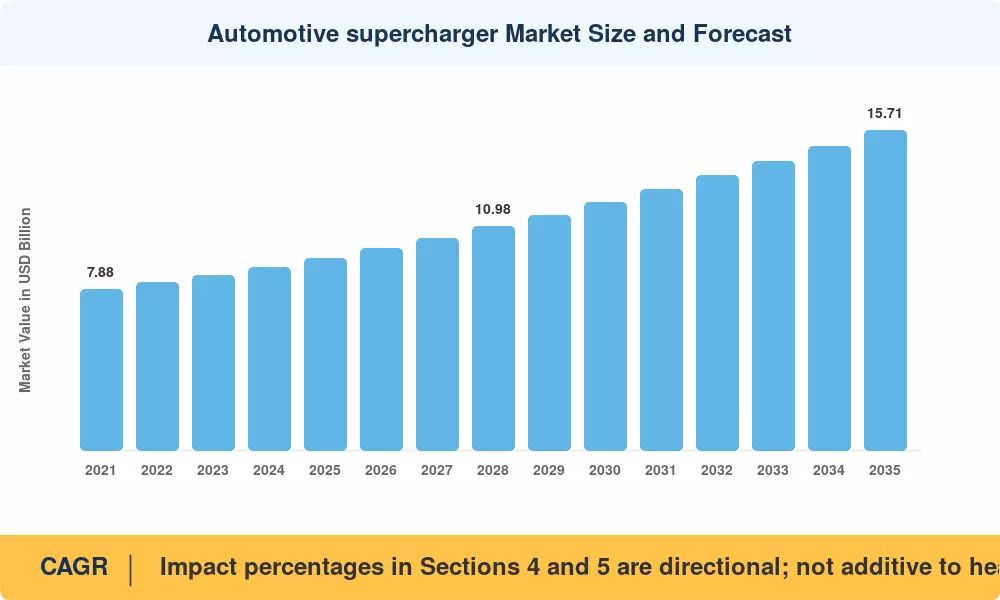
Automotive Supercharger Market to Reach USD 15.71 Billion by 2035, Growing at 5.25% CAGR
Passenger cars represent approximately 68% of the Automotive Supercharger Market by vehicle type, reflecting
Press Release Disclaimer: This is a press release distributed through the XPR Media network. It has not been independently verified by our newsroom.

Passenger cars represent approximately 68% of the Automotive Supercharger Market by vehicle type, reflecting widespread.
NEW YORK, NY, UNITED STATES, August 26, 2026 /EINPresswire.com/ — According to Market Research Future, the Automotive Supercharger Market is projected to grow from USD 9.91 Billion in 2026 to USD 15.71 Billion by 2035, registering a CAGR of 5.25% during the forecast period 2026 to 2035, driven by integration of advanced electric superchargers. This steady growth trajectory reflects the enduring appeal of forced induction technology in the automotive industry, where superchargers continue to enhance engine performance, fuel efficiency, and driving dynamics. The market’s resilience is underpinned by the growing demand for high-performance vehicles, the increasing adoption of downsized engines that require forced induction to maintain power output, and ongoing technological innovations that make superchargers more efficient, reliable, and responsive.
Market Overview
Automotive superchargers are mechanical devices designed to increase internal combustion engine power output by forcing compressed air into the combustion chamber, allowing for more fuel to be burned and generating greater power from a given engine displacement. These forced induction systems are driven directly by the engine via a belt, gear, or shaft connection to the crankshaft, providing immediate throttle response and linear power delivery. The supercharger market encompasses various technologies including centrifugal superchargers, Roots superchargers, twin-screw superchargers, and emerging electric supercharger systems, catering to diverse vehicle applications ranging from high-performance sports cars to commercial vehicles seeking enhanced torque and drivability.
The key growth drivers propelling this market forward include the increasing consumer demand for high-performance vehicles that deliver exhilarating driving experiences, particularly in emerging economies where affluence is growing and automotive enthusiasts seek upgraded driving dynamics. The automotive industry’s trend toward engine downsizing, driven by stringent emission regulations and fuel economy standards, has created substantial demand for superchargers as manufacturers seek to maintain power output from smaller displacement engines. The growing popularity of sports utility vehicles and pickup trucks, which benefit from the enhanced torque and power delivery offered by superchargers, is another significant driver. Additionally, the integration of advanced electric superchargers represents a transformative development, offering instant boost response, improved fuel efficiency, and compatibility with hybrid powertrains, positioning supercharger technology for continued relevance in the evolving automotive landscape.
Technological developments are reshaping the supercharger landscape through continuous innovation. The emergence of electric superchargers represents a paradigm shift in forced induction technology, utilizing electric motors to drive the compressor independently of engine speed, enabling instant boost delivery and eliminating turbo lag. These systems are particularly advantageous in hybrid vehicles where the electric supercharger can be powered by the vehicle’s battery system, providing immediate throttle response while reducing parasitic losses associated with traditional belt-driven superchargers.
📍 Get Free Sample Report for Detailed Market Insights:
https://www.marketresearchfuture.com/sample_request/5757
Market Segmentation
The automotive supercharger market is segmented based on technology, fuel type, power source, sales channel, vehicle type, and regional analysis to provide comprehensive insights into industry dynamics.
By Technology: The market is categorized into Centrifugal Supercharger, Roots Supercharger, and Twin-Screw Supercharger segments. Centrifugal superchargers operate using a high-speed impeller that draws air in and compresses it through centrifugal force, offering high efficiency at higher engine speeds and making them suitable for applications where peak power is the primary objective. These superchargers are commonly used in high-performance applications where top-end power is prioritized. Roots superchargers utilize two rotating lobes to move air from the inlet to the outlet, providing instant boost response and linear power delivery, making them popular in muscle cars and high-performance vehicles where immediate throttle response is valued. Twin-screw superchargers use two interlocking rotors to compress air internally, offering high efficiency across a broad engine speed range. These superchargers are known for their excellent efficiency, compact design, and ability to deliver strong low-end torque, making them suitable for a wide range of applications. The Automotive Turbocharger Market represents a complementary forced induction technology, with superchargers and turbochargers often competing in similar applications while offering distinct performance characteristics.
By Fuel Type: The market is divided into Gasoline and Diesel segments. Gasoline superchargers dominate the market, driven by their widespread application in passenger cars, sports vehicles, and high-performance applications where consumers demand enhanced power and driving excitement. The growing popularity of performance vehicles and the trend toward engine downsizing in gasoline engines are key drivers for this segment. Diesel superchargers serve a significant niche market, particularly in commercial vehicles and heavy-duty applications where enhanced torque and improved combustion efficiency are priorities. Superchargers in diesel engines help improve low-end torque, reduce emissions, and enhance overall engine performance, making them valuable in applications where drivability and load-carrying capability are essential.
By Power Source: The market is segmented into Engine Driven and Electric Motor Driven superchargers. Engine Driven superchargers represent the traditional technology, utilizing mechanical connection to the engine crankshaft via belt, gear, or shaft drive, providing immediate boost delivery proportional to engine speed. These systems remain popular for their simplicity and proven reliability. Electric Motor Driven superchargers represent the emerging segment with the fastest growth potential, utilizing electric motors powered by the vehicle’s electrical system to drive the compressor independently of engine speed. These systems offer instant boost delivery, eliminate parasitic losses associated with mechanical drive systems, and enable integration with hybrid powertrains. Electric superchargers are particularly advantageous in start-stop systems and hybrid vehicles where they can provide immediate throttle response without idling the engine.
By Sales Channel: The market is categorized into Original Equipment Manufacturer and Aftermarket segments. OEM represents the largest sales channel, driven by global vehicle production volumes and the direct integration of superchargers in new vehicles from manufacturers such as Ford, General Motors, Mercedes-AMG, Jaguar Land Rover, and others. The OEM segment is characterized by long-term supply agreements, stringent quality requirements, and close collaboration between automakers and component suppliers. The Aftermarket segment is substantial and growing, driven by automotive enthusiasts seeking to enhance vehicle performance through supercharger upgrades. The aftermarket offers opportunities for manufacturers to capture additional revenue through performance upgrade kits and replacement components, particularly in North America where the performance aftermarket is well-established.
By Vehicle Type: The market covers Passenger Cars and Commercial Vehicles. Passenger cars dominate the market, driven by consumer demand for enhanced driving performance, the trend toward engine downsizing, and the growing availability of supercharged models across various segments from entry-level sport compacts to high-performance luxury vehicles. Commercial vehicles represent a growing segment, particularly in applications where enhanced low-end torque and improved drivability are valuable for load-carrying and towing operations.
By Region: The market covers North America, Europe, South America, Asia Pacific, and the Middle East and Africa. North America dominates the global market, driven by strong consumer preference for high-performance vehicles, a well-established aftermarket culture, and the presence of major supercharger manufacturers. Asia Pacific represents the fastest-growing market, fueled by increasing vehicle production, rising disposable incomes, and growing consumer interest in performance vehicles.
🛒 You can buy this market report at:
https://www.marketresearchfuture.com/checkout?currency=one_user-USD&report_id=5757
Regional Analysis
North America dominates the global automotive supercharger market, driven by strong consumer preference for high-performance vehicles, a well-established automotive aftermarket culture, and the presence of major supercharger manufacturers and automotive brands. The United States leads the regional market with the world’s largest performance vehicle market, where muscle cars, sports cars, and high-performance trucks incorporating supercharger technology are highly popular. American automotive culture places significant value on engine performance and power, creating strong demand for supercharged vehicles and aftermarket supercharger upgrades. The region’s robust aftermarket industry offers numerous opportunities for supercharger manufacturers and suppliers, with enthusiasts frequently upgrading their vehicles with aftermarket supercharger systems. Canada shows similar trends to the U.S., with strong demand for performance vehicles and aftermarket components. Mexico’s growing automotive manufacturing base and increasing vehicle ownership are contributing to market expansion in the region.
Europe represents a technologically advanced market where superchargers are increasingly integrated into downsized engines to maintain performance while meeting stringent emission regulations. Germany leads the European market with major automotive manufacturers like Mercedes-AMG, Audi, and BMW incorporating supercharger technology in their high-performance models. The region’s focus on fuel efficiency and emission reduction has driven adoption of superchargers in downsized engines, enabling smaller displacement engines to deliver power comparable to larger naturally aspirated engines. The growing popularity of hybrid vehicles in Europe is creating opportunities for electric supercharger technology, as these systems integrate well with electrified powertrains and provide instant boost response. The UK, France, and Italy represent significant markets with strong automotive industries and consumer appreciation for performance vehicles. The European aftermarket, while more regulated than North America, offers opportunities for performance upgrades and OEM replacement parts.
Asia Pacific represents the fastest-growing market for automotive superchargers, driven by increasing vehicle production, rising disposable incomes, and growing consumer interest in performance vehicles. China dominates the regional market with the world’s largest automotive production base and a rapidly growing domestic automotive industry. The Chinese automotive market is increasingly embracing performance-oriented models, with domestic and international manufacturers offering supercharged vehicles to meet evolving consumer preferences. Japan and South Korea, as major automotive manufacturing hubs, present significant opportunities for supercharger suppliers, particularly as these markets are known for technological innovation and consumer interest in automotive performance. India represents an emerging market with increasing vehicle production and a growing automotive enthusiast community, creating future potential for supercharger adoption. The Automotive Engine Air Filter Market is closely connected to supercharger developments, as both are integral to engine air management systems and performance optimization, with high-performance air filtration often required alongside supercharger installation.
South America and the Middle East and Africa represent developing markets with growth potential for automotive superchargers. South America, led by Brazil and Argentina, benefits from improving economic conditions and increasing vehicle production. Brazil’s strong automotive manufacturing base supports demand for OEM supercharger systems, while the region’s growing vehicle parc offers aftermarket opportunities. The Middle East, particularly the Gulf Cooperation Council countries, shows strong demand for high-performance and luxury vehicles equipped with supercharger technology, driven by high disposable incomes and consumer preference for powerful vehicles. Africa’s automotive markets are at various stages of development, with South Africa representing the most significant market with a developing automotive manufacturing base and growing consumer interest in performance vehicles.
Competitive Landscape and Key Players
The automotive supercharger market is characterized by intense competition among established manufacturers, with key players focusing on technological innovation, strategic partnerships, and geographic expansion to strengthen their market positions. The market is relatively consolidated, with a mix of global suppliers and specialized performance manufacturers competing for market share.
Major companies operating in this space include Eaton Corporation plc, Honeywell International Inc., Bosch Limited, Vortech Engineering, Whipple Industries, ProCharger, Magnuson Superchargers, Sprintex Ltd, Aisin Seiki Co., Ltd., IHI Corporation, Mitsubishi Heavy Industries, Edelbrock Corporation, and Holley Performance Products. These industry leaders invest significantly in research and development to create innovative supercharger solutions that meet evolving vehicle requirements and performance expectations.
Latest Industry News and Developments
Recent industry developments highlight the dynamic evolution of the automotive supercharger market and the strategic responses of key players to emerging trends. A prominent supercharger manufacturer recently announced the launch of a next-generation electric supercharger system specifically designed for 48-volt mild hybrid vehicles, featuring advanced motor technology and integrated power electronics for instantaneous boost delivery and improved fuel efficiency.
Another significant development involves a leading automotive supplier unveiling a new twin-screw supercharger design featuring advanced rotor profiles and lightweight materials that deliver significant efficiency improvements while reducing noise and vibration. The new design is targeting both OEM and aftermarket applications, reflecting the continued importance of traditional supercharger technology alongside emerging electric systems.
Market Challenges and Opportunities
The automotive supercharger market faces several significant challenges that require strategic responses for sustainable growth. The global transition toward electric vehicles represents the most substantial challenge, as fully electric vehicles do not require superchargers, posing a long-term threat to the conventional supercharger market. The increasing complexity of supercharger systems, particularly electric superchargers, demands continuous technological advancement and investment, challenging manufacturers to maintain competitiveness. Price pressure from automakers seeking cost reductions in vehicle production affects profit margins throughout the supply chain. Supply chain disruptions and raw material price volatility create additional operational challenges for manufacturers.
Emerging opportunities in the market are substantial despite these challenges. The growing popularity of hybrid vehicles represents a significant growth opportunity, as electric superchargers are well-suited for hybrid applications where they can provide instant boost delivery while improving fuel efficiency. The integration of advanced electric vehicle technologies is driving innovation in supercharger design, positioning manufacturers who embrace this trend for success. The performance aftermarket segment continues to offer opportunities for specialized manufacturers, driven by automotive enthusiasts seeking to enhance vehicle performance.
To explore more market insights, visit us at:
https://www.marketresearchfuture.com/reports/automotive-supercharger-market-5757
Final Market Summary
Key factors expected to influence future development include the pace of vehicle electrification, the growth of hybrid vehicle production, technological advances in electric supercharger systems, and the evolving competitive landscape shaped by strategic partnerships and product innovation. The automotive supercharger market continues to play a vital role in the global automotive ecosystem, enabling enhanced engine performance, improved fuel efficiency, and satisfying consumer demand for engaging driving experiences, and will remain an important component of the automotive supply chain for the foreseeable future.
More Related Reports from MRFR Library:
Superyacht Market : https://www.marketresearchfuture.com/reports/superyacht-market-22816
Vehicle Speed Monitoring Device Market : https://www.marketresearchfuture.com/reports/vehicle-speed-monitoring-device-market-22829
Car Carrier Market : https://www.marketresearchfuture.com/reports/car-carrier-market-22840
Bicycle Tire Market : https://www.marketresearchfuture.com/reports/bicycle-tire-market-22928
Battery As A Service Market : https://www.marketresearchfuture.com/reports/battery-as-a-service-market-22939
Autonomous Self Driving Cars Market : https://www.marketresearchfuture.com/reports/autonomous-self-driving-cars-market-23099
Rigid Inflatable Boat Market : https://www.marketresearchfuture.com/reports/rigid-inflatable-boat-market-23206
Train Collision Avoidance System Market : https://www.marketresearchfuture.com/reports/train-collision-avoidance-system-market-23213
Bicycle Gearbox System Market : https://www.marketresearchfuture.com/reports/bicycle-gearbox-system-market-23216
Personal Watercraft Jet Ski Market : https://www.marketresearchfuture.com/reports/personal-watercraft-jet-ski-market-23223
Market Research Future
Market Research Future
+1 855-661-4441
email us here
Legal Disclaimer:
EIN Presswire provides this news content “as is” without warranty of any kind. We do not accept any responsibility or liability
for the accuracy, content, images, videos, licenses, completeness, legality, or reliability of the information contained in this
article. If you have any complaints or copyright issues related to this article, kindly contact the author above.

Media gallery