Study: An inside look at how college students think about and use AI
Spokeo reports that a study shows college students widely use AI as a supportive tool, emphasizing human expertise in
Press Release Disclaimer: This is a press release distributed through the XPR Media network. It has not been independently verified by our newsroom.



izzet ugutmen // Shutterstock
Study: An inside look at how college students think about and use AI
There are plenty of hot-button issues on college campuses as students go back to school this fall, but perhaps the biggest of them all is artificial intelligence. Some reports claim that AI usage among undergrads is near-universal, with one study finding that over 80% of students at an elite university used AI during the course of earning their degree. But students themselves are often wary of how agentic AI — AI systems capable of taking multistep actions with limited human input — is shaping the job market and career prospects. That sentiment was clearly demonstrated by the mixed reactions AI-focused commencement speeches received during the 2026 graduation season.
To get to the bottom of how college students truly feel about both using AI and the future of AI, Spokeo tasked its 2026 scholarship applicants to envision breakthrough use cases for agentic AI and to disclose if and how they used AI in the process of their application.
What resulted was a self-reported dataset on how students actually use AI when the stakes are real. It also revealed that they envision a future where AI plays a supporting role to human expertise, not as a replacement for deep human knowledge and critical thinking.
Confirming Trends in AI Use Among College Students
A 2026 Gallup study of thousands of U.S. college students found that more than half now use AI in coursework at least weekly, with adoption skewing higher in business, tech, and engineering programs. Another study of students in the U.K. conducted by the Higher Education Policy Institute found that undergraduates using generative AI tools in assessments jumped from over half in 2024 to nearly 9 in 10 students in 2025.
Finally, a separate survey conducted by the University of Chicago found that while 60% of students said that they personally used AI, 90% believe that the average student on campus uses AI regularly. Researchers pointed to social desirability bias as a likely explanation for this gap — explaining that some students may underreport their own AI use because admitting to it feels like admitting they couldn’t do the work independently. (This desirability bias likely contributes to the large variation in AI usage numbers found across different studies and surveys we’ve cited in this article.)
Spokeo’s applicant pool’s self-reported AI use roughly aligns with this data: 54% of students disclosed some form of AI use during the course of completing their scholarship application, while 46% disclosed no AI use. It’s worth noting that the Spokeo team did not use AI checkers when reviewing applications, so the social desirability bias found by the University of Chicago researchers may be at play in these numbers as well.
.png)
Spokeo
It is also worth digging into how the applicants who reported AI use said they used the technology: The large majority of that group — roughly 7 in 10 applicants — used it in a supporting role. Rather than having AI tools generate the actual content of their application essays, these students leaned on AI to help brainstorm, outline, organize, and edit essays they’d written themselves. A much smaller portion of scholarship applicants reported using AI to draft or expand all or a portion of their essays. But even these applicants made it clear that they then personalized, verified, and finalized what their AI tool of choice created for them.
This aligns with what researchers are finding as well. In the same study that found 80% of students at a single university used generative AI, 61% of those students reported using it for “augmentation purposes” and frequently described AI tools like ChatGPT as an “on-demand tutor” to help explain concepts and proofread assignments.
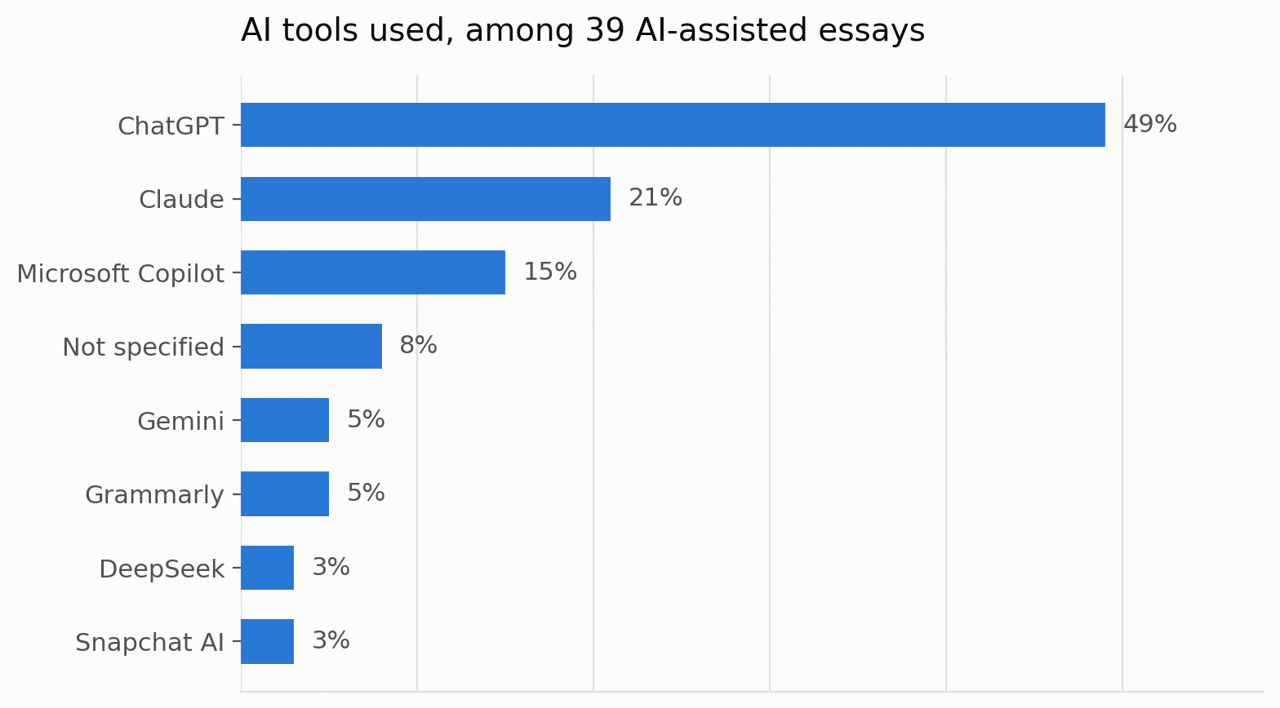
Spokeo
Regardless of how the essays were written, the vast majority of applications were independently rated “highly original” or “exceptional,” rather than generic, by the scholarship panel. Strong writing appeared across both groups — and even essays submitted by applicants who disclosed AI use read as deeply personal, underscoring the impact of human-led co-creation with generative AI tools.
The Role of Agentic AI: Supporter, not Leader
The scholarship data didn’t just reveal how students use AI, it also uncovered an interesting through line in how students envision the future of agentic AI.
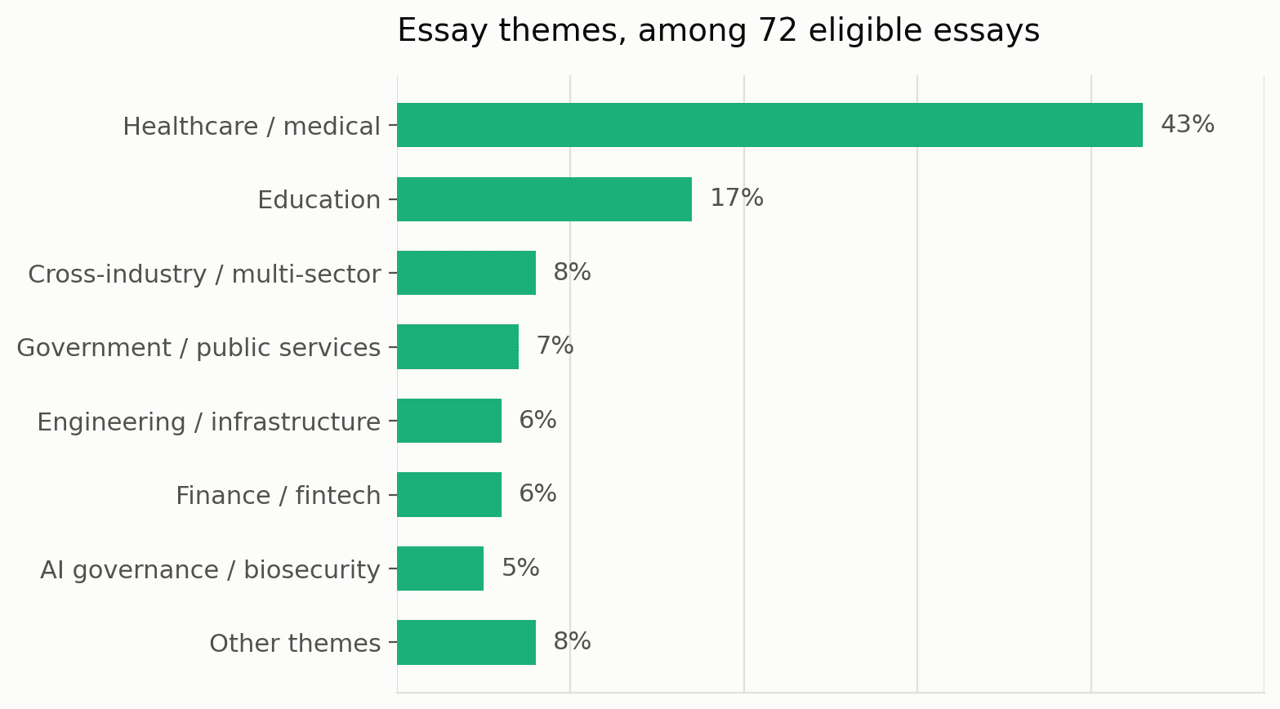
Scholarship applicants were prompted to describe breakthrough applications of agentic AI in the essays they submitted. A few common themes emerged across applications: Healthcare/medical use cases dominated the responses, with 43% of essays discussing ways agentic AI could change those fields. Education came next, with 17% of essays discussing agentic AI applications in the school system, followed by government, engineering, and finance applications.
Spokeo
But nearly every essay, regardless of theme, casts AI in a coordinator, advisor, or mentor role. Human professionals, whether they be doctors, teachers, or lawyers, explicitly kept the final judgment across almost every single application. Even in essays that disclosed the use of AI to help draft content, students stressed that the ideas, experiences, and final analysis contained within were their own.
The vision of agentic AI’s future presented by the scholarship applicants was overwhelmingly optimistic, hopeful, and passionate. While few essays had a more cautionary tone, it’s clear that most students are comfortable existing in a world where agentic AI plays a similar role to how they use AI today: as a supporting role, not a substitute for human expertise, authority, and authorship.
AI’s Place on Campus
Asking applicants to show their work didn’t result in a flood of AI-generated essays. Instead, it revealed something closer to what’s happening across college campuses across the country and around the world: Increasingly, students are leaning on AI to supplement and support the work that they’re already doing, not replace it altogether.
This story was produced by Spokeo and reviewed and distributed by Stacker.